Design an End-to-End Production ML System
Learn Design an End-to-End Production ML System through clear explanations, practical guidance, common mistakes, troubleshooting, and focused exercises in.
The fastest way to misunderstand an End-to-End Production ML System is to memorize its surface syntax without learning the boundary it controls. We will use build, evaluate and explain models on a small tabular dataset before progressing to deep learning as a concrete thread, so each choice has an observable consequence rather than becoming a list of disconnected facts.
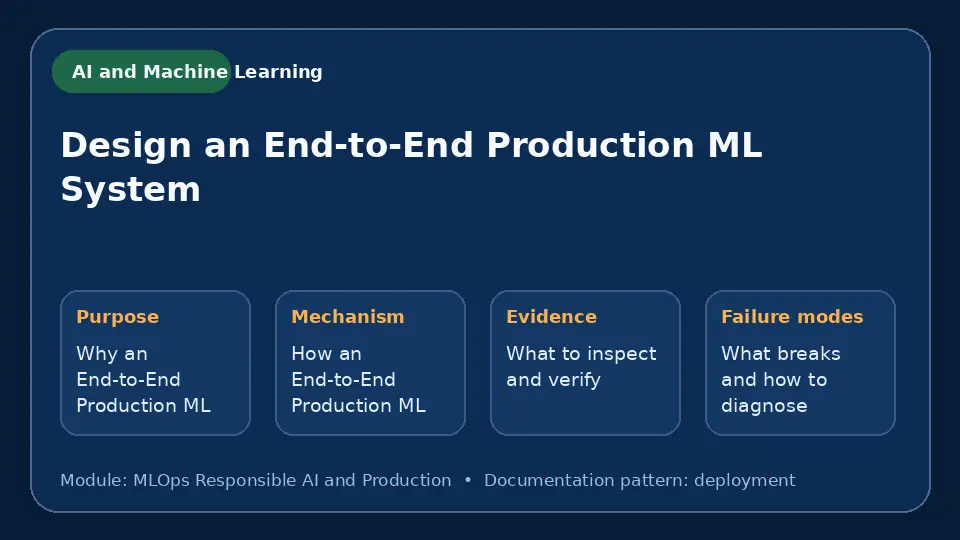
In this lesson
- Place an End-to-End Production ML System in the context of the MLOps Responsible AI and Production module rather than treating it as an isolated feature.
- Build a mental model for what happens before, during, and after the operation.
- Work through a reproducible example connected to the scenario: build, evaluate and explain models on a small tabular dataset before progressing to deep learning.
- Inspect the result and distinguish evidence from assumption.
- Recognize failure modes, misleading shortcuts, and production constraints.
- Leave with a verification checklist and a practical exercise rather than a memorized snippet.
From source to deployable output
For a machine-learning practitioner, an End-to-End Production ML System becomes useful when it changes a decision you can verify. The learner should be able to describe the inputs, the operation, and the result in plain language. In the running scenario—build, evaluate and explain models on a small tabular dataset before progressing to deep learning—the input might be a value, request, record, event, configuration setting, or user action. The operation is the part controlled by an End-to-End Production ML System; the result is the state you can inspect afterward. Keeping those three pieces explicit prevents the lesson from collapsing into memorized commands. The specific test here is about an End-to-End Production ML System: change one relevant input, configuration value or boundary and make sure the result still matches the contract described above.
The practical question behind design an end-to-end production ml system is not simply whether the feature exists, but what behavior it gives you control over. Documentation often presents the API or syntax first because reference pages are written for lookup. A tutorial has a different job. Here the explanation begins with intent, then shows the smallest concrete implementation, then adds constraints. That order lets you understand why a setting or line exists before you are asked to remember its spelling. For an End-to-End Production ML System, apply this check in the context of the MLOps Responsible AI and Production workflow before carrying the assumption into later AI and Machine Learning work. In AI and Machine Learning lesson 76 — Design an End-to-End Production ML System, use that observation as the checkpoint for this exact MLOps Responsible AI and Production topic rather than generalizing it beyond the evidence.
In the MLOps Responsible AI and Production part of this learning path, an End-to-End Production ML System is deliberately introduced now because later lessons depend on the boundary it establishes. At the professional stage, the goal is not to cover every advanced option. It is to establish the correct mental model and the verification habit that later pages can extend. Where the platform has version-specific behavior, prefer the current official documentation and check the version shown by your own tools before assuming an older screenshot or blog post is authoritative. For an End-to-End Production ML System, apply this check in the context of the MLOps Responsible AI and Production workflow before carrying the assumption into later AI and Machine Learning work. In AI and Machine Learning lesson 76 — Design an End-to-End Production ML System, use that observation as the checkpoint for this exact MLOps Responsible AI and Production topic rather than generalizing it beyond the evidence.
Environment-specific configuration
Before adding more syntax, make the state of the system observable. That habit matters especially when working with an End-to-End Production ML System. The learner should be able to describe the inputs, the operation, and the result in plain language. In the running scenario—build, evaluate and explain models on a small tabular dataset before progressing to deep learning—the input might be a value, request, record, event, configuration setting, or user action. The operation is the part controlled by an End-to-End Production ML System; the result is the state you can inspect afterward. Keeping those three pieces explicit prevents the lesson from collapsing into memorized commands. The specific test here is about an End-to-End Production ML System: change one relevant input, configuration value or boundary and make sure the result still matches the contract described above. In AI and Machine Learning lesson 76 — Design an End-to-End Production ML System, use that observation as the checkpoint for this exact MLOps Responsible AI and Production topic rather than generalizing it beyond the evidence.
There are usually several ways to accomplish the same visible result. The important skill is knowing which guarantees differ when you choose one form of an End-to-End Production ML System over another. Documentation often presents the API or syntax first because reference pages are written for lookup. A tutorial has a different job. Here the explanation begins with intent, then shows the smallest concrete implementation, then adds constraints. That order lets you understand why a setting or line exists before you are asked to remember its spelling. In this lesson's an End-to-End Production ML System example, record the evidence you observed rather than treating the rule as a slogan; that note becomes useful when the next MLOps Responsible AI and Production exercise changes the conditions. In AI and Machine Learning lesson 76 — Design an End-to-End Production ML System, use that observation as the checkpoint for this exact MLOps Responsible AI and Production topic rather than generalizing it beyond the evidence.
For a machine-learning practitioner, an End-to-End Production ML System becomes useful when it changes a decision you can verify. At the professional stage, the goal is not to cover every advanced option. It is to establish the correct mental model and the verification habit that later pages can extend. Where the platform has version-specific behavior, prefer the current official documentation and check the version shown by your own tools before assuming an older screenshot or blog post is authoritative. In this lesson's an End-to-End Production ML System example, record the evidence you observed rather than treating the rule as a slogan; that note becomes useful when the next MLOps Responsible AI and Production exercise changes the conditions.
Questions to answer about an End-to-End Production ML System
- What is the smallest input or state that makes an End-to-End Production ML System observable?
- What does success look like, and how can you prove it without relying on a vague UI message?
- Which configuration, permissions, types, versions or environment details can change the result?
- Which failure is most likely for a beginner, and what evidence distinguishes it from a different failure?
- What should remain true after the example is repeated, automated or moved to another environment?
Build and validation gates
In the MLOps Responsible AI and Production part of this learning path, an End-to-End Production ML System is deliberately introduced now because later lessons depend on the boundary it establishes. The learner should be able to describe the inputs, the operation, and the result in plain language. In the running scenario—build, evaluate and explain models on a small tabular dataset before progressing to deep learning—the input might be a value, request, record, event, configuration setting, or user action. The operation is the part controlled by an End-to-End Production ML System; the result is the state you can inspect afterward. Keeping those three pieces explicit prevents the lesson from collapsing into memorized commands. Keep this point tied to an End-to-End Production ML System. The same general engineering habit appears elsewhere, but the evidence and failure signals in this MLOps Responsible AI and Production lesson are specific to this mechanism. In AI and Machine Learning lesson 76 — Design an End-to-End Production ML System, use that observation as the checkpoint for this exact MLOps Responsible AI and Production topic rather than generalizing it beyond the evidence.
A production system rarely fails at the exact line shown in a beginner example, so this section connects an End-to-End Production ML System to the surrounding runtime and operational context. Documentation often presents the API or syntax first because reference pages are written for lookup. A tutorial has a different job. Here the explanation begins with intent, then shows the smallest concrete implementation, then adds constraints. That order lets you understand why a setting or line exists before you are asked to remember its spelling. The specific test here is about an End-to-End Production ML System: change one relevant input, configuration value or boundary and make sure the result still matches the contract described above.
Before adding more syntax, make the state of the system observable. That habit matters especially when working with an End-to-End Production ML System. At the professional stage, the goal is not to cover every advanced option. It is to establish the correct mental model and the verification habit that later pages can extend. Where the platform has version-specific behavior, prefer the current official documentation and check the version shown by your own tools before assuming an older screenshot or blog post is authoritative. Keep this point tied to an End-to-End Production ML System. The same general engineering habit appears elsewhere, but the evidence and failure signals in this MLOps Responsible AI and Production lesson are specific to this mechanism.
Package/version the result
For a machine-learning practitioner, an End-to-End Production ML System becomes useful when it changes a decision you can verify. The learner should be able to describe the inputs, the operation, and the result in plain language. In the running scenario—build, evaluate and explain models on a small tabular dataset before progressing to deep learning—the input might be a value, request, record, event, configuration setting, or user action. The operation is the part controlled by an End-to-End Production ML System; the result is the state you can inspect afterward. Keeping those three pieces explicit prevents the lesson from collapsing into memorized commands. In this lesson's an End-to-End Production ML System example, record the evidence you observed rather than treating the rule as a slogan; that note becomes useful when the next MLOps Responsible AI and Production exercise changes the conditions.
The practical question behind design an end-to-end production ml system is not simply whether the feature exists, but what behavior it gives you control over. Documentation often presents the API or syntax first because reference pages are written for lookup. A tutorial has a different job. Here the explanation begins with intent, then shows the smallest concrete implementation, then adds constraints. That order lets you understand why a setting or line exists before you are asked to remember its spelling. Keep this point tied to an End-to-End Production ML System. The same general engineering habit appears elsewhere, but the evidence and failure signals in this MLOps Responsible AI and Production lesson are specific to this mechanism.
This section needs a different question from the earlier explanation: what would make an End-to-End Production ML System fail specifically while working through Package/version the result? Choose one realistic boundary, reproduce it deliberately, and inspect the first useful diagnostic or intermediate value. The aim in Design an End-to-End Production ML System is to recognize the mechanism under changed conditions, not to repeat the same successful path with different wording.
Evidence table
| What you inspect | What it tells you | What it does not prove |
|---|---|---|
| Source/configuration for an End-to-End Production ML System | What you asked the platform/runtime to do | That the request actually succeeded |
| Build/validation output | Whether static checks accepted the artifact | That production data and permissions behave correctly |
| Runtime/result output | What happened for this input | That every edge case is safe |
| Logs/diagnostics | Where the system spent time or failed | The root cause without interpretation |
| Repeat test | Whether behavior is reproducible | That the design is optimal |
Deploy safely
Before adding more syntax, make the state of the system observable. That habit matters especially when working with an End-to-End Production ML System. The learner should be able to describe the inputs, the operation, and the result in plain language. In the running scenario—build, evaluate and explain models on a small tabular dataset before progressing to deep learning—the input might be a value, request, record, event, configuration setting, or user action. The operation is the part controlled by an End-to-End Production ML System; the result is the state you can inspect afterward. Keeping those three pieces explicit prevents the lesson from collapsing into memorized commands. For an End-to-End Production ML System, apply this check in the context of the MLOps Responsible AI and Production workflow before carrying the assumption into later AI and Machine Learning work.
There are usually several ways to accomplish the same visible result. The important skill is knowing which guarantees differ when you choose one form of an End-to-End Production ML System over another. Documentation often presents the API or syntax first because reference pages are written for lookup. A tutorial has a different job. Here the explanation begins with intent, then shows the smallest concrete implementation, then adds constraints. That order lets you understand why a setting or line exists before you are asked to remember its spelling. The specific test here is about an End-to-End Production ML System: change one relevant input, configuration value or boundary and make sure the result still matches the contract described above.
For a machine-learning practitioner, an End-to-End Production ML System becomes useful when it changes a decision you can verify. At the professional stage, the goal is not to cover every advanced option. It is to establish the correct mental model and the verification habit that later pages can extend. Where the platform has version-specific behavior, prefer the current official documentation and check the version shown by your own tools before assuming an older screenshot or blog post is authoritative. The specific test here is about an End-to-End Production ML System: change one relevant input, configuration value or boundary and make sure the result still matches the contract described above.
Health checks and smoke tests
In Health checks and smoke tests, look at an End-to-End Production ML System through the constraint that matters in this part of the lesson: make the relevant state visible before you change it, then compare the observed result with the contract you expected. In AI and Machine Learning, this prevents a local-looking edit from hiding an environment, data, permission, lifecycle or runtime assumption. Record the evidence from this step because the next decision in the MLOps Responsible AI and Production module should be based on what you measured rather than on a repeated rule of thumb.
A production system rarely fails at the exact line shown in a beginner example, so this section connects an End-to-End Production ML System to the surrounding runtime and operational context. Documentation often presents the API or syntax first because reference pages are written for lookup. A tutorial has a different job. Here the explanation begins with intent, then shows the smallest concrete implementation, then adds constraints. That order lets you understand why a setting or line exists before you are asked to remember its spelling. Keep this point tied to an End-to-End Production ML System. The same general engineering habit appears elsewhere, but the evidence and failure signals in this MLOps Responsible AI and Production lesson are specific to this mechanism. In AI and Machine Learning lesson 76 — Design an End-to-End Production ML System, use that observation as the checkpoint for this exact MLOps Responsible AI and Production topic rather than generalizing it beyond the evidence.
Before adding more syntax, make the state of the system observable. That habit matters especially when working with an End-to-End Production ML System. At the professional stage, the goal is not to cover every advanced option. It is to establish the correct mental model and the verification habit that later pages can extend. Where the platform has version-specific behavior, prefer the current official documentation and check the version shown by your own tools before assuming an older screenshot or blog post is authoritative. The specific test here is about an End-to-End Production ML System: change one relevant input, configuration value or boundary and make sure the result still matches the contract described above. In AI and Machine Learning lesson 76 — Design an End-to-End Production ML System, use that observation as the checkpoint for this exact MLOps Responsible AI and Production topic rather than generalizing it beyond the evidence.
Worked example: an End-to-End Production ML System
The following python example is written specifically for this lesson. Read the requirement first, then predict the important result before running or reproducing it.
from sklearn.datasets import load_iris
from sklearn.model_selection import train_test_split
from sklearn.linear_model import LogisticRegression
from sklearn.metrics import accuracy_score

X, y = load_iris(return_X_y=True)
X_train, X_test, y_train, y_test = train_test_split(
    X, y, test_size=0.25, random_state=42, stratify=y
)
model = LogisticRegression(max_iter=500)
model.fit(X_train, y_train)
pred = model.predict(X_test)
print("accuracy:", round(accuracy_score(y_test, pred), 3))
For an End-to-End Production ML System, apply this check in the context of the MLOps Responsible AI and Production workflow before carrying the assumption into later AI and Machine Learning work.
Expected observation
A reproducible classification accuracy value on the held-out test set.
Read the example deliberately
- Line/construct 1:
from sklearn.datasets import load_iris— identify what state or contract this introduces, then trace where that state is consumed. - Line/construct 2:
from sklearn.model_selection import train_test_split— identify what state or contract this introduces, then trace where that state is consumed. - Line/construct 3:
from sklearn.linear_model import LogisticRegression— identify what state or contract this introduces, then trace where that state is consumed. - Line/construct 4:
from sklearn.metrics import accuracy_score— identify what state or contract this introduces, then trace where that state is consumed. - Line/construct 5:
X, y = load_iris(return_X_y=True)— identify what state or contract this introduces, then trace where that state is consumed. - Line/construct 6:
X_train, X_test, y_train, y_test = train_test_split(— identify what state or contract this introduces, then trace where that state is consumed. - Line/construct 7:
X, y, test_size=0.25, random_state=42, stratify=y— identify what state or contract this introduces, then trace where that state is consumed. - Line/construct 8:
)— identify what state or contract this introduces, then trace where that state is consumed. - Line/construct 9:
model = LogisticRegression(max_iter=500)— identify what state or contract this introduces, then trace where that state is consumed. - Line/construct 10:
model.fit(X_train, y_train)— identify what state or contract this introduces, then trace where that state is consumed.
Do not stop at “it ran.” Change one meaningful value related to an End-to-End Production ML System, predict the new result, run/reproduce the example again, and explain why the output changed. That mutation test is a stronger check of understanding than copying the original result.
Rollback and recovery
For a machine-learning practitioner, an End-to-End Production ML System becomes useful when it changes a decision you can verify. The learner should be able to describe the inputs, the operation, and the result in plain language. In the running scenario—build, evaluate and explain models on a small tabular dataset before progressing to deep learning—the input might be a value, request, record, event, configuration setting, or user action. The operation is the part controlled by an End-to-End Production ML System; the result is the state you can inspect afterward. Keeping those three pieces explicit prevents the lesson from collapsing into memorized commands. For an End-to-End Production ML System, apply this check in the context of the MLOps Responsible AI and Production workflow before carrying the assumption into later AI and Machine Learning work.
The practical question behind design an end-to-end production ml system is not simply whether the feature exists, but what behavior it gives you control over. Documentation often presents the API or syntax first because reference pages are written for lookup. A tutorial has a different job. Here the explanation begins with intent, then shows the smallest concrete implementation, then adds constraints. That order lets you understand why a setting or line exists before you are asked to remember its spelling. In this lesson's an End-to-End Production ML System example, record the evidence you observed rather than treating the rule as a slogan; that note becomes useful when the next MLOps Responsible AI and Production exercise changes the conditions.
In the MLOps Responsible AI and Production part of this learning path, an End-to-End Production ML System is deliberately introduced now because later lessons depend on the boundary it establishes. At the professional stage, the goal is not to cover every advanced option. It is to establish the correct mental model and the verification habit that later pages can extend. Where the platform has version-specific behavior, prefer the current official documentation and check the version shown by your own tools before assuming an older screenshot or blog post is authoritative. Keep this point tied to an End-to-End Production ML System. The same general engineering habit appears elsewhere, but the evidence and failure signals in this MLOps Responsible AI and Production lesson are specific to this mechanism.
Secrets and identity at deployment time
This section needs a different question from the earlier explanation: what would make an End-to-End Production ML System fail specifically while working through Secrets and identity at deployment time? Choose one realistic boundary, reproduce it deliberately, and inspect the first useful diagnostic or intermediate value. The aim in Design an End-to-End Production ML System is to recognize the mechanism under changed conditions, not to repeat the same successful path with different wording.
For the Secrets and identity at deployment time part of Design an End-to-End Production ML System, use a separate verification pass rather than repeating the earlier explanation. Focus on an End-to-End Production ML System under one changed condition and write down the before/after evidence. This is verification pass 2 for AI and Machine Learning lesson 76: the useful outcome is a concrete observation—output, state, diagnostic, generated artifact, query result or test result—that another learner can reproduce in the MLOps Responsible AI and Production workflow.
For a machine-learning practitioner, an End-to-End Production ML System becomes useful when it changes a decision you can verify. At the professional stage, the goal is not to cover every advanced option. It is to establish the correct mental model and the verification habit that later pages can extend. Where the platform has version-specific behavior, prefer the current official documentation and check the version shown by your own tools before assuming an older screenshot or blog post is authoritative. Keep this point tied to an End-to-End Production ML System. The same general engineering habit appears elsewhere, but the evidence and failure signals in this MLOps Responsible AI and Production lesson are specific to this mechanism.
Failure-mode matrix
| Symptom | Likely category | First evidence to collect |
|---|---|---|
| The an End-to-End Production ML System behavior never occurs | configuration / control flow | verify the relevant code/configuration is actually reached |
| Build or validation fails | syntax / type / unsupported option | read the first meaningful diagnostic, not the last cascade message |
| Works locally but not elsewhere | environment / version / permission | compare runtime versions, identity, configuration and data |
| Result is valid but wrong | assumption / data shape / business rule | inspect intermediate values and boundary conditions |
| Intermittent behavior | concurrency / timing / external dependency | add timestamps, correlation IDs or deterministic reproduction |
Observability after release
In the MLOps Responsible AI and Production part of this learning path, an End-to-End Production ML System is deliberately introduced now because later lessons depend on the boundary it establishes. The learner should be able to describe the inputs, the operation, and the result in plain language. In the running scenario—build, evaluate and explain models on a small tabular dataset before progressing to deep learning—the input might be a value, request, record, event, configuration setting, or user action. The operation is the part controlled by an End-to-End Production ML System; the result is the state you can inspect afterward. Keeping those three pieces explicit prevents the lesson from collapsing into memorized commands. The specific test here is about an End-to-End Production ML System: change one relevant input, configuration value or boundary and make sure the result still matches the contract described above.
A production system rarely fails at the exact line shown in a beginner example, so this section connects an End-to-End Production ML System to the surrounding runtime and operational context. Documentation often presents the API or syntax first because reference pages are written for lookup. A tutorial has a different job. Here the explanation begins with intent, then shows the smallest concrete implementation, then adds constraints. That order lets you understand why a setting or line exists before you are asked to remember its spelling. For an End-to-End Production ML System, apply this check in the context of the MLOps Responsible AI and Production workflow before carrying the assumption into later AI and Machine Learning work.
Before adding more syntax, make the state of the system observable. That habit matters especially when working with an End-to-End Production ML System. At the professional stage, the goal is not to cover every advanced option. It is to establish the correct mental model and the verification habit that later pages can extend. Where the platform has version-specific behavior, prefer the current official documentation and check the version shown by your own tools before assuming an older screenshot or blog post is authoritative. For an End-to-End Production ML System, apply this check in the context of the MLOps Responsible AI and Production workflow before carrying the assumption into later AI and Machine Learning work.
Common release failures
For a machine-learning practitioner, an End-to-End Production ML System becomes useful when it changes a decision you can verify. The learner should be able to describe the inputs, the operation, and the result in plain language. In the running scenario—build, evaluate and explain models on a small tabular dataset before progressing to deep learning—the input might be a value, request, record, event, configuration setting, or user action. The operation is the part controlled by an End-to-End Production ML System; the result is the state you can inspect afterward. Keeping those three pieces explicit prevents the lesson from collapsing into memorized commands. Keep this point tied to an End-to-End Production ML System. The same general engineering habit appears elsewhere, but the evidence and failure signals in this MLOps Responsible AI and Production lesson are specific to this mechanism. In AI and Machine Learning lesson 76 — Design an End-to-End Production ML System, use that observation as the checkpoint for this exact MLOps Responsible AI and Production topic rather than generalizing it beyond the evidence.
The practical question behind design an end-to-end production ml system is not simply whether the feature exists, but what behavior it gives you control over. Documentation often presents the API or syntax first because reference pages are written for lookup. A tutorial has a different job. Here the explanation begins with intent, then shows the smallest concrete implementation, then adds constraints. That order lets you understand why a setting or line exists before you are asked to remember its spelling. The specific test here is about an End-to-End Production ML System: change one relevant input, configuration value or boundary and make sure the result still matches the contract described above.
In the MLOps Responsible AI and Production part of this learning path, an End-to-End Production ML System is deliberately introduced now because later lessons depend on the boundary it establishes. At the professional stage, the goal is not to cover every advanced option. It is to establish the correct mental model and the verification habit that later pages can extend. Where the platform has version-specific behavior, prefer the current official documentation and check the version shown by your own tools before assuming an older screenshot or blog post is authoritative. The specific test here is about an End-to-End Production ML System: change one relevant input, configuration value or boundary and make sure the result still matches the contract described above. In AI and Machine Learning lesson 76 — Design an End-to-End Production ML System, use that observation as the checkpoint for this exact MLOps Responsible AI and Production topic rather than generalizing it beyond the evidence.
Repeatability through automation
Before adding more syntax, make the state of the system observable. That habit matters especially when working with an End-to-End Production ML System. The learner should be able to describe the inputs, the operation, and the result in plain language. In the running scenario—build, evaluate and explain models on a small tabular dataset before progressing to deep learning—the input might be a value, request, record, event, configuration setting, or user action. The operation is the part controlled by an End-to-End Production ML System; the result is the state you can inspect afterward. Keeping those three pieces explicit prevents the lesson from collapsing into memorized commands. In this lesson's an End-to-End Production ML System example, record the evidence you observed rather than treating the rule as a slogan; that note becomes useful when the next MLOps Responsible AI and Production exercise changes the conditions.
This section needs a different question from the earlier explanation: what would make an End-to-End Production ML System fail specifically while working through Repeatability through automation? Choose one realistic boundary, reproduce it deliberately, and inspect the first useful diagnostic or intermediate value. The aim in Design an End-to-End Production ML System is to recognize the mechanism under changed conditions, not to repeat the same successful path with different wording.
For a machine-learning practitioner, an End-to-End Production ML System becomes useful when it changes a decision you can verify. At the professional stage, the goal is not to cover every advanced option. It is to establish the correct mental model and the verification habit that later pages can extend. Where the platform has version-specific behavior, prefer the current official documentation and check the version shown by your own tools before assuming an older screenshot or blog post is authoritative. For an End-to-End Production ML System, apply this check in the context of the MLOps Responsible AI and Production workflow before carrying the assumption into later AI and Machine Learning work.
Production-readiness checklist
For this part of Design an End-to-End Production ML System, move beyond the earlier mental model and ask how the behavior survives repetition. Run or reproduce the step twice, change the ordering or boundary case where safe, and verify that the same invariant still holds. A reliable MLOps Responsible AI and Production workflow is one that produces evidence you can compare, not one that succeeds only when the exact tutorial sequence is copied.
Now apply an End-to-End Production ML System to the current Production-readiness checklist concern. Start from the smallest state that demonstrates the behavior, vary one input or configuration choice, and explain the result in terms of the AI and Machine Learning runtime or platform. If two outcomes look similar in the UI, use logs, return values, generated artifacts, query results, tests or another concrete signal to distinguish them.
Define the release artifact
Now apply an End-to-End Production ML System to the current Define the release artifact concern. Start from the smallest state that demonstrates the behavior, vary one input or configuration choice, and explain the result in terms of the AI and Machine Learning runtime or platform. If two outcomes look similar in the UI, use logs, return values, generated artifacts, query results, tests or another concrete signal to distinguish them.
This section needs a different question from the earlier explanation: what would make an End-to-End Production ML System fail specifically while working through Define the release artifact? Choose one realistic boundary, reproduce it deliberately, and inspect the first useful diagnostic or intermediate value. The aim in Design an End-to-End Production ML System is to recognize the mechanism under changed conditions, not to repeat the same successful path with different wording.
A production-oriented walkthrough for an End-to-End Production ML System
1. Establish the an End-to-End Production ML System behavior
2. Inspect the an End-to-End Production ML System behavior
3. Implement the an End-to-End Production ML System behavior
A useful variation is to introduce one boundary case that is plausible for an End-to-End Production ML System: an empty value, a missing permission, an unexpected type, a repeated operation, an unavailable dependency, or a larger-than-normal input. The exact case depends on the technology, but the reasoning is the same—state the invariant you expect to remain true, then verify it explicitly. The specific test here is about an End-to-End Production ML System: change one relevant input, configuration value or boundary and make sure the result still matches the contract described above. In AI and Machine Learning lesson 76 — Design an End-to-End Production ML System, use that observation as the checkpoint for this exact MLOps Responsible AI and Production topic rather than generalizing it beyond the evidence.
4. Exercise the an End-to-End Production ML System behavior
5. Challenge the an End-to-End Production ML System behavior
For the A production-oriented walkthrough for an End-to-End Production ML System part of Design an End-to-End Production ML System, use a separate verification pass rather than repeating the earlier explanation. Focus on an End-to-End Production ML System under one changed condition and write down the before/after evidence. This is verification pass 2 for AI and Machine Learning lesson 76: the useful outcome is a concrete observation—output, state, diagnostic, generated artifact, query result or test result—that another learner can reproduce in the MLOps Responsible AI and Production workflow.
6. Verify the an End-to-End Production ML System behavior
7. Harden the an End-to-End Production ML System behavior
A useful variation is to introduce one boundary case that is plausible for an End-to-End Production ML System: an empty value, a missing permission, an unexpected type, a repeated operation, an unavailable dependency, or a larger-than-normal input. The exact case depends on the technology, but the reasoning is the same—state the invariant you expect to remain true, then verify it explicitly. For an End-to-End Production ML System, apply this check in the context of the MLOps Responsible AI and Production workflow before carrying the assumption into later AI and Machine Learning work.
8. Document the an End-to-End Production ML System behavior
Mistakes that distort the an End-to-End Production ML System mental model
Treating an End-to-End Production ML System as syntax instead of behavior
If you can reproduce the syntax but cannot predict the state after it runs, the lesson is not finished. Rewrite the example in your own words and name the input, operation and observable result.
Copying a configuration from a different version
AI and Machine Learning tooling evolves. Compare the documentation version, runtime/tool version and project settings before assuming that a screenshot or command from another environment applies unchanged.
Verifying only the happy path
A successful first run proves one path. Add at least one negative or boundary case relevant to an End-to-End Production ML System. The failure should be intentional and the diagnostic should make sense.
Hiding the important state behind too much abstraction
Abstraction is useful after the behavior is understood. During the first implementation of an End-to-End Production ML System, keep the decisive state and control flow visible enough to debug.
A practical diagnostic path for an End-to-End Production ML System
Use this order when an End-to-End Production ML System does not behave as expected:
- Reproduce the smallest failing case.
- Confirm the actual version/toolchain/environment.
- Capture the first meaningful diagnostic or unexpected value.
- Verify identity, permissions and configuration if the operation crosses a service boundary.
- Inspect intermediate state rather than only the final UI.
- Change one variable and rerun.
- Compare the corrected behavior with a negative case.
- Record the final cause so the same failure is faster to diagnose next time.
Your turn: prove the behavior
Extend the worked scenario so that an End-to-End Production ML System must handle one additional real constraint. Choose one: a second data shape, a failed dependency, an invalid input, a permission difference, a repeat operation, or a larger workload. Before implementing the change, write down the behavior you expect and the evidence that will prove it.
Your result is complete when another learner can reproduce the change from your notes, observe the expected behavior, and intentionally trigger at least one documented failure without damaging their environment. Keep this point tied to an End-to-End Production ML System. The same general engineering habit appears elsewhere, but the evidence and failure signals in this MLOps Responsible AI and Production lesson are specific to this mechanism.
Before you move on
- Can you define an End-to-End Production ML System without using the exact wording of an API/reference page?
- Can you identify the boundary where an End-to-End Production ML System begins and where another concept takes over?
- Can you predict the result of the worked example before running it?
- Can you explain one failure from evidence rather than guessing?
- Can you name one production constraint that the beginner example intentionally simplifies?
- Can you repeat the example from a clean state?
The durable ideas from an End-to-End Production ML System
- an End-to-End Production ML System is useful because it controls observable behavior, not because it adds another piece of syntax to memorize.
- Verification belongs in the workflow: build/check, run/reproduce, inspect, challenge, and repeat.
- The MLOps Responsible AI and Production module uses this lesson as a foundation for the next decisions in the AI and Machine Learning learning path.
- Official documentation is the source of truth for version-specific contracts; tutorials should teach you how to read and apply those contracts.
Source material for version-specific details
The following primary documentation was used as a factual reference map for this lesson. ScrutnLearn's explanation is original synthesis rather than copied documentation prose.